Black Forest Conservancy is a project to combat loss of biodiversity in the area of the historical Black Forest of the Adelaide Plains. It encourages planting of species which grew in the area prior to European settlement.
In 1836, when Europeans first arrived in 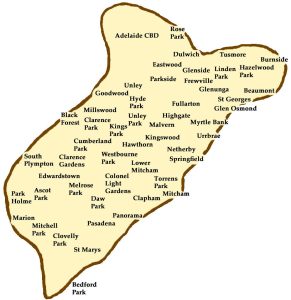 South Australia, the Black Forest was an area of approximately 50 square kilometres extending south of the River Torrens and west of the Adelaide Hills.
It was bounded, roughly, by what is now the Adelaide CBD in the northwest, the suburb of Burnside in the northeast, Sturt Creek near Marion in the southwest, and the suburb of Bedford Park in the southeast.
The Black Forest may have had the greatest biodiversity in South Australia.
It was more densely wooded than other parts of the Adelaide Plains. It was also quite wet, at least compared with the area today. Rather than flowing through concrete drains, waterways such as Brownhill Creek gently flooded in Winter to irrigate the surrounding vegetation.
The traditional owners of the Adelaide Plains, the Kaurna people, managed the Black Forest sustainably for tens of thousands of years. However, within 50 years of first European settlement, most of the original vegetation was gone. Clearing for agriculture and settlement removed most understorey species, particularly grasses, and led to widespread environmental degradation.
We know of over 300 plant species which probably grew in the historical Black Forest (the actual number could have been much greater). Of these, most, perhaps all, are now probably rare or extinct in the area

No more posts